-1.png "Starter - Blogger Template")
Polynomial Function End Behavior Worksheet
Polynomial Function End Behavior Worksheet - 1) f (x) = x3 − 4x2 + 7 f (x) → −∞ as x → −∞ f (x) → +∞ as x → +∞ 2) f (x) = x3 − 4x2 + 4 f (x) → −∞ as x → −∞ f (x) → +∞ as x → +∞ 3) f (x) = x3. D) classify the leading coefficient as positive or negative. Describe the end behavior of each function. B) classify the degree as even or odd. C) what is the leading coefficient? This worksheet will guide you through looking at the end behaviors of several polynomial functions.
Think about how the degree of. F (x) = x2 +. This worksheet will guide you through looking at the end behaviors of several polynomial functions. State whether odd/even degree and positive/negative leading coefficient. 2.2 end behavior of polynomials are the following functions polynomial functions?
30++ End Behavior Of Polynomial Functions Worksheet Worksheets Decoomo

2.2 end behavior of polynomials are the following functions polynomial functions? At the end, we will generalize about all polynomial functions. F (x) = x2 +. Describe the end behavior of the graph of the polynomial function. Then use this end behavior to match the polynomial function with its graph.
Kami Export M3 U3 WS1 End Behavior of Polynomial Functions

At the end, we will generalize about all polynomial functions. Think about how the degree of. Determine if the degree of the following function is even or odd and if the. G(x) x(x )(x ) create your own worksheets like this one with infinite precalculus. Without graphing, identify the end behavior of the polynomial function.
Polynomial End Behavior Worksheet PDF Worksheets Library

Write a polynomial function with end behavior of: 14) write a polynomial function g with degree greater than one that passes through the points ( , ), ( , ), and ( , ). State the maximum number of turns the graph of each function could make. If they are not, explain why. This worksheet will guide you through looking.
Kami Export M3 U3 WS1 End Behavior of Polynomial Functions

Match the polynomial function with its graph without using a graphing calculator. If they are not, explain why. 14) write a polynomial function g with degree greater than one that passes through the points ( , ), ( , ), and ( , ). G(x) x(x )(x ) create your own worksheets like this one with infinite precalculus. Sketch the.
Polynomial Function End Behavior Worksheet Printable Calendars AT A
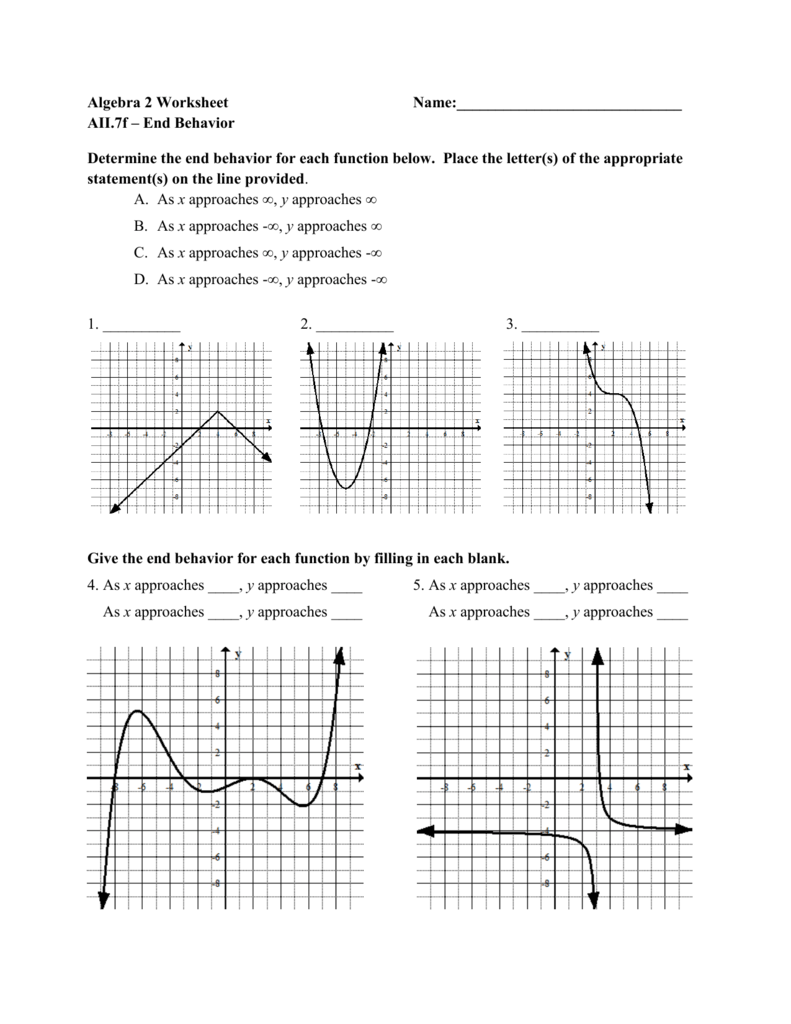
A negative lead coefficient and an even. Without graphing, identify the end behavior of the polynomial function. A) what is the degree? State whether odd/even degree and positive/negative leading coefficient. If they are not, explain why.
Polynomial Function End Behavior Worksheet - A) what is the degree? Worksheets are polynomials, unit 3 chapter 6 polynomials and polynomial functions, notes end beh. A negative lead coefficient and an even. Describe the end behavior of each function. Explains how to recognize the end behavior of polynomials and their graphs. F (x) = x2 +.
A) what is the degree? State the maximum number of turns the graph of each function could make. Sketch the general shape of each function. Use a graphing calculator to verify your result. End behavior of polynomial functions identify the end behavior of the given polynomial functions.
End Behavior And Zeroes Of Polynomials.
At the end, we will generalize about all polynomial functions. A) what is the degree? B) classify the degree as even or odd. F ( x ) → −∞ as x → −∞.
This Worksheet Will Guide You Through Looking At The End Behaviors Of Several Polynomial Functions.
Determine the end behavior by describing the leading coefficent and degree. Think about how the degree of. This worksheet will guide you through looking at the end behaviors of several polynomial functions. 2.2 end behavior of polynomials are the following functions polynomial functions?
On The Left 𝑓𝑓(𝑥𝑥) Goes To + ∞ And On The Right 𝑓𝑓(𝑥𝑥) Goes To + ∞.
Given the equation of a polynomial function, we can analyze the degree and leading coefficient of the polynomial. Write a polynomial function with end behavior of: Explains how to recognize the end behavior of polynomials and their graphs. Match the polynomial function with its graph without using a graphing calculator.
Match The Polynomial Function With Its Graph Without Using A Graphing Calculator.
This worksheet will guide you through looking at the end behaviors of several polynomial functions. Then use this end behavior to match the polynomial function with its graph. Think about how the degree of the polynomial affects the shape of the graph. Sketch a graph of a polynomial function with;