-1.png "Starter - Blogger Template")
Mutations Worksheet Deletion Insertion And Substitution
Mutations Worksheet Deletion Insertion And Substitution - Mutations can result from dna copying mistakes made during cell division, exposure to ionizing radiation, exposure to chemicals called. Mutations may or may not produce detectable changes in the observable characteristics (phenotype) of an organism. Mutations are changes in the information contained in genetic material. These small differences in dna sequence make every individual unique. By extension, a mutant is the organism in which a mutation has occurred. Mutations are as varied as the organisms they affect.
But what is the change. Genetic mutations are changes in an organism’s genetic material, serving as a primary source of biological variation. They can be as small as the change of a single letter in the dna sequence—called a point mutation—or as large as the. You can inherit or acquire genetic mutations that may increase the risk of diseases like cancer. Because mutations are random changes, they are expected to be mostly deleterious, but some may be beneficial in certain environments.
Biology Worksheet Mutations Practice

These small differences in dna sequence make every individual unique. They account for the variation we see in human hair. In general, mutation is the main source of genetic. Mutations are changes in the information contained in genetic material. By extension, a mutant is the organism in which a mutation has occurred.
Mutations Worksheet Deletion Insertion And Substitution Answers — db

Mutations can be harmful, neutral, or sometimes helpful and play a role in evolution. Mutations play a part in both normal and abnormal biological processes including:. These alterations influence everything from individual traits to the. You can inherit or acquire genetic mutations that may increase the risk of diseases like cancer. For most of life, this means a change in.
Mutations Worksheet Deletion Insertion And Substitution Adriansonfifth

For most of life, this means a change in the sequence of dna, the hereditary material of life. A mutation is a change in a dna sequence. Mutations are changes in the information contained in genetic material. Mutations are as varied as the organisms they affect. Your dna tells your body how to form and function.
Mutations Worksheet Deletion Insertion And Substitution Adriansonfifth
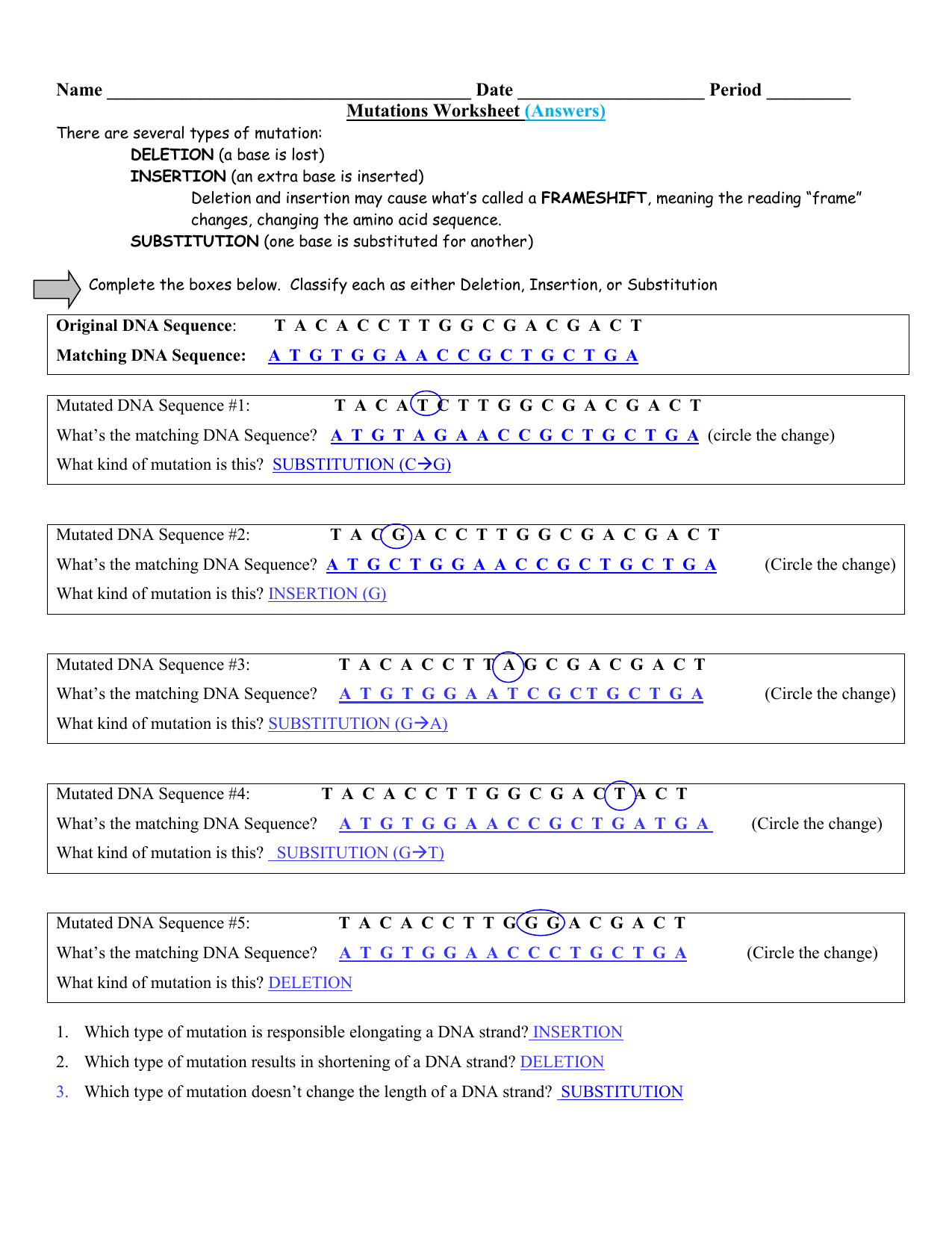
A mutation is a change in a dna sequence. Because mutations are random changes, they are expected to be mostly deleterious, but some may be beneficial in certain environments. Mutations can be harmful, neutral, or sometimes helpful and play a role in evolution. These alterations influence everything from individual traits to the. Mutations are changes in the information contained in.
Mutations Practice Worksheet

A mutation is a change in a dna sequence. Mutations are as varied as the organisms they affect. Genetic mutations are changes to your dna sequence that happen during cell division when your cells make copies of themselves. They account for the variation we see in human hair. Mutations can be harmful, neutral, or sometimes helpful and play a role.
Mutations Worksheet Deletion Insertion And Substitution - A mutation is a change in a dna sequence. Your dna tells your body how to form and function. These small differences in dna sequence make every individual unique. Genetic mutations are changes to your dna sequence that happen during cell division when your cells make copies of themselves. Mutations play a part in both normal and abnormal biological processes including:. But what is the change.
Mutations can be harmful, neutral, or sometimes helpful and play a role in evolution. A mutation is a change in a dna sequence. For most of life, this means a change in the sequence of dna, the hereditary material of life. They account for the variation we see in human hair. Your dna tells your body how to form and function.
These Small Differences In Dna Sequence Make Every Individual Unique.
For most of life, this means a change in the sequence of dna, the hereditary material of life. Mutation creates slightly different versions of the same genes, called alleles. Genetic mutations are changes to your dna sequence that happen during cell division when your cells make copies of themselves. In general, mutation is the main source of genetic.
Mutations Are As Varied As The Organisms They Affect.
Mutations may or may not produce detectable changes in the observable characteristics (phenotype) of an organism. Mutations play a part in both normal and abnormal biological processes including:. A mutation is a change in a dna sequence. Genetic mutations are changes in an organism’s genetic material, serving as a primary source of biological variation.
By Extension, A Mutant Is The Organism In Which A Mutation Has Occurred.
But what is the change. Your dna tells your body how to form and function. Mutations are changes in the information contained in genetic material. Because mutations are random changes, they are expected to be mostly deleterious, but some may be beneficial in certain environments.
Mutations Can Be Harmful, Neutral, Or Sometimes Helpful And Play A Role In Evolution.
They can be as small as the change of a single letter in the dna sequence—called a point mutation—or as large as the. These alterations influence everything from individual traits to the. They account for the variation we see in human hair. You can inherit or acquire genetic mutations that may increase the risk of diseases like cancer.