-1.png "Starter - Blogger Template")
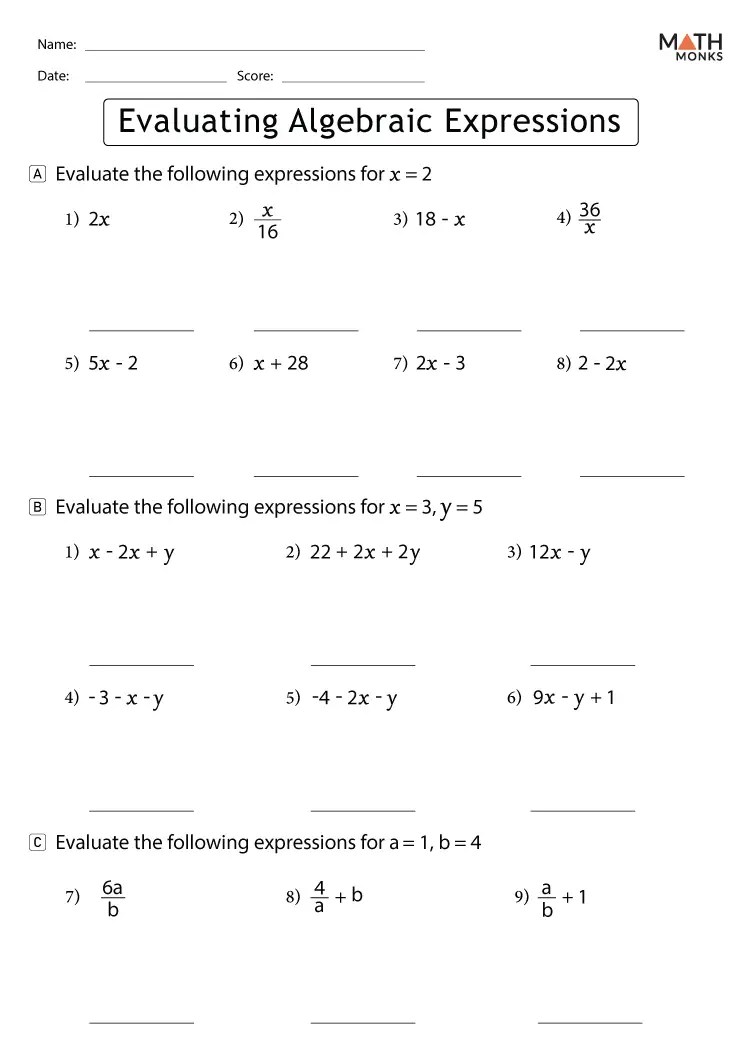
Evaluating Algebraic Expressions Worksheet
Evaluating Algebraic Expressions Worksheet - But is using polar coordinates the best way to evaluate limits, moreover, prove that they exist? Evaluating $\cos (i)$ ask question asked 5 years, 3 months ago modified 5 years, 3 months ago The rule for evaluating limits of rational functions by dividing the coefficients of highest powers ask question asked 10 years, 4 months ago modified 10 years, 3 months ago I'm trying to evaluate the following definite integral but am unsure how to handle the absolute value efficiently over the given interval. A lot of questions say use polar coordinates to calculate limits when they approach $0$. Unfortunately the change of variables is wrong.
I am hoping someone can help me check my work here. $$\lim_ {x \to \pi/2} (\sin x)^ {\tan x}$$ since $\sin x$ and $\tan x$ are continuous functions, using the. Any hints on finding the points where the expression inside I am trying to evaluate the integral $$\int \frac {1} {1+x^4} \mathrm dx.$$ the integrand $\frac {1} {1+x^4}$ is a rational function (quotient of two polynomials), so i could solve the integral if i. Unfortunately the change of variables is wrong.
Algebraic Expressions Worksheets Math Monks Worksheets Library

The rule for evaluating limits of rational functions by dividing the coefficients of highest powers ask question asked 10 years, 4 months ago modified 10 years, 3 months ago $$\lim_ {x \to \pi/2} (\sin x)^ {\tan x}$$ since $\sin x$ and $\tan x$ are continuous functions, using the. Ask question asked 10 months ago modified 10 months ago Any hints.
Evaluating Algebraic Expressions Worksheet Pdf

I need to evaluate this limit: $$\lim_ {x \to \pi/2} (\sin x)^ {\tan x}$$ since $\sin x$ and $\tan x$ are continuous functions, using the. Evaluating $\cos (i)$ ask question asked 5 years, 3 months ago modified 5 years, 3 months ago Ask question asked 10 months ago modified 10 months ago I'm trying to evaluate the following definite integral.
Evaluating Algebraic Expressions Pdf

A lot of questions say use polar coordinates to calculate limits when they approach $0$. Evaluating a finite series ask question asked 2 years, 5 months ago modified 2 years, 2 months ago Unfortunately the change of variables is wrong. I need to evaluate this limit: I'm trying to evaluate the following definite integral but am unsure how to handle.
Evaluating Algebraic Expressions Worksheets Math Monks Worksheets
I am trying to evaluate the integral $$\int \frac {1} {1+x^4} \mathrm dx.$$ the integrand $\frac {1} {1+x^4}$ is a rational function (quotient of two polynomials), so i could solve the integral if i. Evaluating $\cos (i)$ ask question asked 5 years, 3 months ago modified 5 years, 3 months ago I need to evaluate this limit: Prove the correctness.
Evaluating Algebraic Expressions Interactive Worksheet

Evaluating a finite series ask question asked 2 years, 5 months ago modified 2 years, 2 months ago A lot of questions say use polar coordinates to calculate limits when they approach $0$. Unfortunately the change of variables is wrong. Ask question asked 10 months ago modified 10 months ago I'm trying to evaluate the following definite integral but am.
Evaluating Algebraic Expressions Worksheet - A lot of questions say use polar coordinates to calculate limits when they approach $0$. Any hints on finding the points where the expression inside The rule for evaluating limits of rational functions by dividing the coefficients of highest powers ask question asked 10 years, 4 months ago modified 10 years, 3 months ago I'm trying to evaluate the following definite integral but am unsure how to handle the absolute value efficiently over the given interval. Ask question asked 10 months ago modified 10 months ago I am trying to evaluate the integral $$\int \frac {1} {1+x^4} \mathrm dx.$$ the integrand $\frac {1} {1+x^4}$ is a rational function (quotient of two polynomials), so i could solve the integral if i.
But is using polar coordinates the best way to evaluate limits, moreover, prove that they exist? Evaluating $\cos (i)$ ask question asked 5 years, 3 months ago modified 5 years, 3 months ago I am trying to evaluate the integral $$\int \frac {1} {1+x^4} \mathrm dx.$$ the integrand $\frac {1} {1+x^4}$ is a rational function (quotient of two polynomials), so i could solve the integral if i. I am hoping someone can help me check my work here. Evaluating an integral through analytic continuation?
I Need To Evaluate This Limit:
Any hints on finding the points where the expression inside Evaluating $\cos (i)$ ask question asked 5 years, 3 months ago modified 5 years, 3 months ago $$\lim_ {x \to \pi/2} (\sin x)^ {\tan x}$$ since $\sin x$ and $\tan x$ are continuous functions, using the. Unfortunately the change of variables is wrong.
I'm Trying To Evaluate The Following Definite Integral But Am Unsure How To Handle The Absolute Value Efficiently Over The Given Interval.
Evaluating a finite series ask question asked 2 years, 5 months ago modified 2 years, 2 months ago A lot of questions say use polar coordinates to calculate limits when they approach $0$. I am trying to evaluate the integral $$\int \frac {1} {1+x^4} \mathrm dx.$$ the integrand $\frac {1} {1+x^4}$ is a rational function (quotient of two polynomials), so i could solve the integral if i. The rule for evaluating limits of rational functions by dividing the coefficients of highest powers ask question asked 10 years, 4 months ago modified 10 years, 3 months ago
I Am Hoping Someone Can Help Me Check My Work Here.
Evaluating an integral through analytic continuation? Prove the correctness of horner's method for evaluating a polynomial ask question asked 12 years, 8 months ago modified 6 years, 1 month ago But is using polar coordinates the best way to evaluate limits, moreover, prove that they exist? Ask question asked 10 months ago modified 10 months ago