-1.png "Starter - Blogger Template")
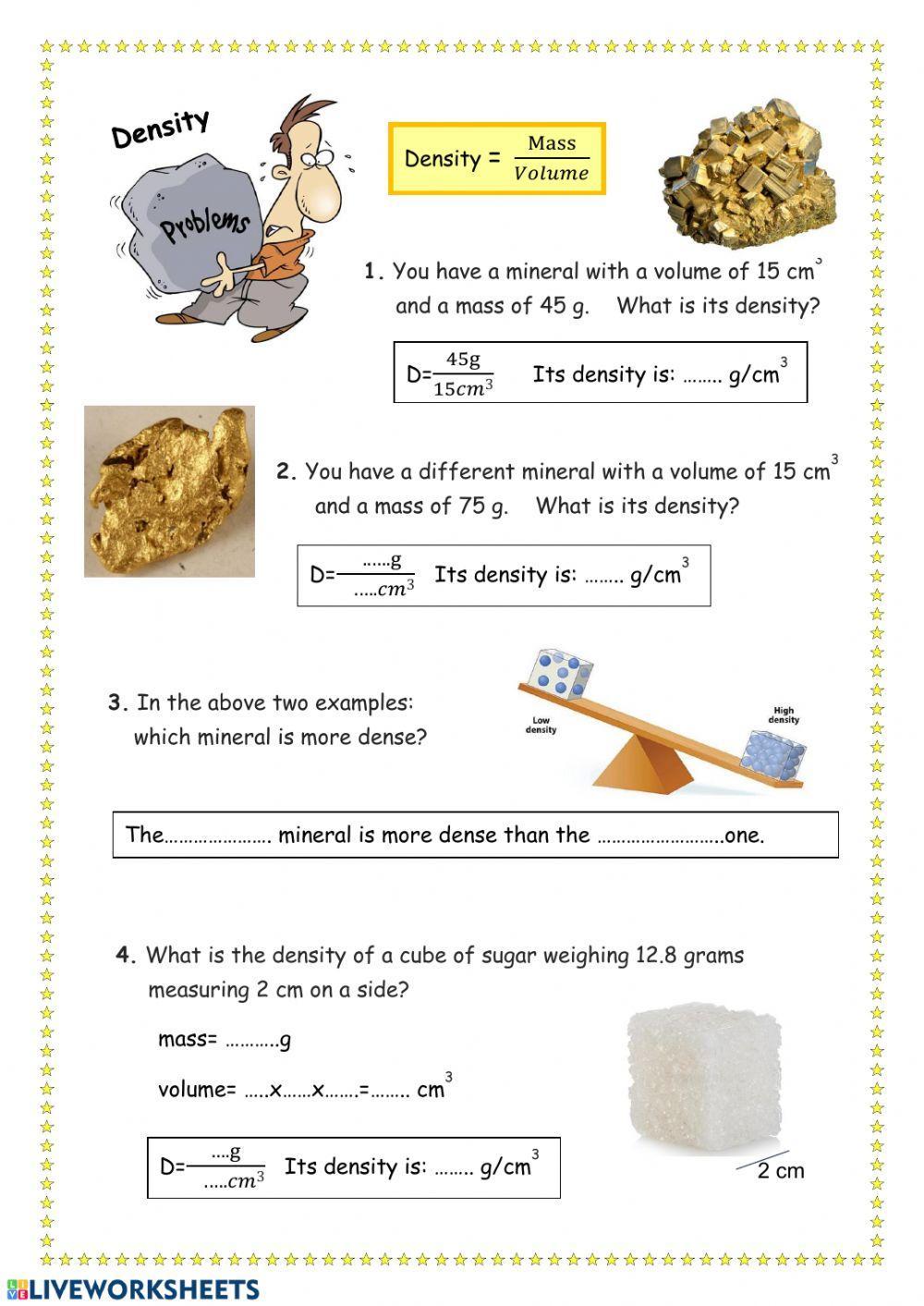
Density Practice Problem Worksheet
Density Practice Problem Worksheet - Gain a comfort using the formula d = m/v and explore how density. Mathematically speaking, density is the ratio of the mass to the volume. Physically speaking, density is the measure of how much matter is squeezed in a given space. The symbol most often used for density is ρ (the lower case greek letter rho), although the latin letter d. Summary density is defined as the mass of an object divided by its volume. To calculate density, you divide the mass by the volume:
Explore how density explains why some objects float while others. Summary density is defined as the mass of an object divided by its volume. These differences in density explain everyday phenomena like floating and sinking, as well as engineering choices such as why airplanes are not built out of very dense metals. This lesson explains density as the physical property in chemistry that quantifies how mass is concentrated in a given volume. Gain a comfort using the formula d = m/v and explore how density.
Density Practice Problem Worksheet Answers

Summary density is defined as the mass of an object divided by its volume. Density (volumetric mass density or specific mass) is the ratio of a substance's mass to its volume. To calculate density, you divide the mass by the volume: Density can be used as a conversion factor between mass and volume. Learn about density as the relationship between.
Density Practice Problem Worksheet Proworksheet

Density (volumetric mass density or specific mass) is the ratio of a substance's mass to its volume. To find density, divide the mass by the volume of an object using the formula density = mass/volume. Mathematically speaking, density is the ratio of the mass to the volume. These differences in density explain everyday phenomena like floating and sinking, as well.
47 Density Practice Problems Worksheet Chessmuseum Template Library

Summary density is defined as the mass of an object divided by its volume. Mass can be written as m, and volume. These differences in density explain everyday phenomena like floating and sinking, as well as engineering choices such as why airplanes are not built out of very dense metals. Density is how much mass fits in a certain volume,.
Density Practice Worksheet 1 Study notes Chemistry Docsity

The symbol most often used for density is ρ (the lower case greek letter rho), although the latin letter d. This lesson explains density as the physical property in chemistry that quantifies how mass is concentrated in a given volume. Density = mass ÷ volume. Density can be used as a conversion factor between mass and volume. Mathematically speaking, density.
Free density practice problem worksheet, Download Free density practice
Mathematically speaking, density is the ratio of the mass to the volume. This lesson explains density as the physical property in chemistry that quantifies how mass is concentrated in a given volume. Density can be used as a conversion factor between mass and volume. Summary density is defined as the mass of an object divided by its volume. The symbol.
Density Practice Problem Worksheet - Density can be used as a conversion factor between mass and volume. Density is how much mass fits in a certain volume, like grams per cubic centimeter. Density is commonly expressed in units of gram per cubic. To find density, divide the mass by the volume of an object using the formula density = mass/volume. Mass can be written as m, and volume. Gain a comfort using the formula d = m/v and explore how density.
To calculate density, you divide the mass by the volume: Physically speaking, density is the measure of how much matter is squeezed in a given space. These differences in density explain everyday phenomena like floating and sinking, as well as engineering choices such as why airplanes are not built out of very dense metals. Mass can be written as m, and volume. Density = mass ÷ volume.
Mathematically Speaking, Density Is The Ratio Of The Mass To The Volume.
Gain a comfort using the formula d = m/v and explore how density. To calculate density, you divide the mass by the volume: Physically speaking, density is the measure of how much matter is squeezed in a given space. The symbol most often used for density is ρ (the lower case greek letter rho), although the latin letter d.
Density Is How Much Mass Fits In A Certain Volume, Like Grams Per Cubic Centimeter.
Density = mass ÷ volume. Density is often written in mathematics as the symbol p or d. This lesson explains density as the physical property in chemistry that quantifies how mass is concentrated in a given volume. Explore how density explains why some objects float while others.
Density Can Be Used As A Conversion Factor Between Mass And Volume.
Density, mass per unit volume of a substance. The formula for density is d=m/v, where d is density, m is mass, and v is volume. Density is commonly expressed in units of gram per cubic. To find density, divide the mass by the volume of an object using the formula density = mass/volume.
Learn About Density As The Relationship Between Mass And Volume And How To Calculate And Compare The Densities Of Different Materials.
Density (volumetric mass density or specific mass) is the ratio of a substance's mass to its volume. Mass can be written as m, and volume. Summary density is defined as the mass of an object divided by its volume. These differences in density explain everyday phenomena like floating and sinking, as well as engineering choices such as why airplanes are not built out of very dense metals.